Posts

The Road to Nazism in Milton Meyer's "They Thought They Were Free"

Why did Nazism take root in Germany in 1933? What conditions do and do not move a society in the direction of a repressive fascist dictatorship? They Thought They Were Free: The Germans, 1933-45 by Milton Meyer, explores the experience of ten "regular" Germans in the years during and leading up to World War II. The book grapples with questions of social responsibility and the moral culpability of the average German, but I read the book with an eye toward the question: what led Germany down its path toward ruin and fascism? How did the German people become so vociferously anti-Semitic and what led the them to support and adore Hitler? There seems to be six political conditions or themes that weave their way through this book to shed light on these questions. Theme 1: A Geopolitics of Siege Milton Meyer repeatedly emphasizes the role that geopolitical pressure played in moving Germany toward Nazism. Specifically, the German people felt encircled by enemies and oppressed...

And the King will reply, ‘Truly I tell you, whatever you did for one of the least of these brothers of Mine, you did for Me.’

From Milton Mayer, "They Thought They Were Free": “You know, Herr Professor, we are told that not a sparrow falls without God’s care; I am not being light when I say this—that not a person ‘fell,’ fell ill or in need, lost his job or his house, without the Party’s caring. No organization had ever done this before in Germany, maybe nowhere else. Believe me, such an organization is irresistible to men. No one in Germany was alone in his troubles—”   “Except,” I said, “‘inferior races’ and opponents of the regime.”   “Of course,” he said, “that is understood, but they were few, they were outside society, ‘over the fence,’ and nobody thought about them.”   “But these, too, were ‘sparrows.’”   “Yes,” he said. “Could these,” I said, “have been ‘the least of them,’ of whom Jesus spoke?”   “Herr Professor, we didn’t see it that way. We were wrong, sinful, but we didn’t see it that way. We saw ‘the least of them’ among our own pe...

Collective Punishment

A few weeks ago, a shul-friend of mine casually suggested the following "solution" to the Arab-Israeli conflict: "for every one they kill of us, the IDF should kill five of them." I think the left is quick (and correct!) to jump on the moral reprehensibility of this kind of collective punishment - of wanting to bomb all Palestinians into submission, or a Kahanist ethnic cleansing, but could benefit by responding to the efficacy of these proposals as well. Telling acquaintances that their politics are abhorrent to me won't change their minds, but a conversation about the efficacy of their politics could be productive. Here are three sources on the (in)effectiveness of bombing an enemy into submission that I came across in recent readings: 1 - In his book "On Killing, Lt. Col. Dave Grossman discusses the military theory that inspired the extensive strategic bombing campaigns that were waged during WWII, and the consequences of those campaigns. Prior ...

I Made a Video On The "Dictator's Handbook" and Democratic Backsliding

Image

On The Anxieties of "Empire"

Chris Hayes, on the dynamics of "Colony" and "Nation" in America: In the Colony, violence looms and failure to comply can be fatal. Sandra Bland, a 28-year-old black woman who died in a Texas prison cell, was pulled over because she didn’t signal a lane change. Walter Scott, the 50-year-old black man shot in the back as he fled a North Charleston police officer, was pulled over because one of the three brake lights on his car was out. Freddie Gray simply made eye contact with a police officer and started to move swiftly in the other direction. If you live in the Nation, the criminal-justice system functions like your laptop’s operating system, quietly humming in the background, doing what it needs to do to allow you to be your most efficient, functional self. In the Colony, the system functions like a computer virus: it intrudes constantly, it interrupts your life at the most inconvenient times, and it does this as a matter of course. The disruption itself ...

A Guide to Debating Ben Shapiro on Poverty in America

Shapiro's Stance: Class and income mobility exists in our society Anyone can succeed in America by simply: a) finishing high school, b) waiting until married to have kids, c) getting a job Poor people are poor because they "suck at managing their money" We don’t need to worry about poverty in America because being poor here is better than being poor in most places in the world Opening Question: Student: There’s a popular Youtube video of you speaking at a public school, with many low-income students in the audience and you say something along the lines of: “if you are permanently poor in the United States it’s because you suck with money” ( video , DailyWire article ). Shapiro: Yes, and then the principal of the school interrupted me and said I "went too far" and told the kids they were all free to leave. Student: Right. What does it mean to "suck with money"? What is this skill that all poor people lack?  Shapiro: It means...

A Guide for Debating Ben Shapiro on Institutional Racism

Image
Shapiro's Stance: Racists exists, but institutional racism does not exist. There are even advantages to being black in America today (scholarships, affirmative action, etc.). Institutional racism existed as late as the 70s and 80s, but has since been resolved Ben Shapiro: “point me to an example of an institution that is racist and we can fight that racism together.” Ben Shapiro: “if someone has been the target of institutional racism they can find a good lawyer and sue that institution.” For anyone to “make it” in America they need to: a) finish high school, b) wait for marriage to have children, c) get a job - this has nothing to do with race. Failure to “make it” in America, reflects a moral failing on the part of the person who failed to make it. Claims of institutional racism reflects a failure to appreciate how wonderful and prosperous life in America is today. Institutional racism is a tool of "the left" for invoking government action and curtailing freedo...

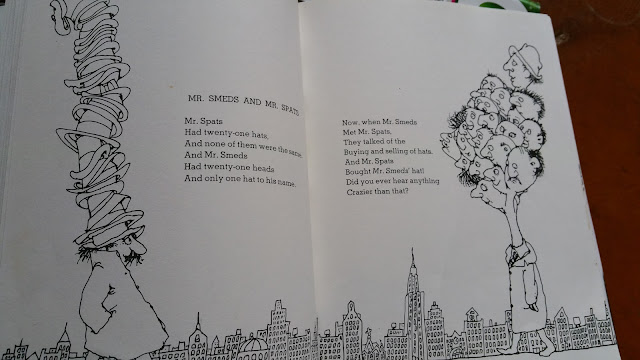
Mr. Smeds and Mr. Spats

Image
From Shel Silverstein's A Light in the Attic : From Wikipedia's Great Famine (Ireland) article, about food exports from Ireland during the famine ( https://en.wikipedia.org/wiki/Great_Famine_(Ireland)#Irish_food_exports_during_Famine ): Throughout the entire period of the Famine, Ireland was exporting enormous quantities of food. In the magazine History Ireland (1997, issue 5, pp. 32–36), Christine Kinealy, a Great Hunger scholar, lecturer, and Drew University professor, relates her findings: Almost 4,000 vessels carried food from Ireland to the ports of Bristol, Glasgow, Liverpool, and London during 1847, when 400,000 Irish men, women, and children died of starvation and related diseases. She also writes that Irish exports of calves, livestock (except pigs), bacon, and ham actually increased during the Famine. This food was shipped under British military guard from the most famine-stricken parts of Ireland; Ballina, Ballyshannon, Bantry, Dingle, Killala, Kilrush,...

What "Left" Means to Me

Image
Contrary to the characterizations I most often hear, I don’t care about diversity, I don’t care about inclusion or love or tolerance. I don't want government to orchestrate our economy, and I don’t want to live in a society where everyone is equal or everyone is treated the same. For me, being on the left means I am interested in the ways institutions operate, wield power, and whether or not that power is being abused. There are two major themes in my world of progressive thinking and reading: 1) what evidence can we find that suggests the existence of systemic disenfranchisement, 2) what are the specific mechanisms of disenfranchisement and oppression that explain this evidence. Below I will give specific examples from each of these two themes. Theme I - Evidence of Systemic Disenfranchisement: In 2013, the net worth of the median black household in the United States was $11,000. The net worth of the median white household was $141,900 1 . This wealth gap between the races ...

My Favorite Scene From the Book: Do Androids Dream of Electric Sheep

Contains minor spoilers. For me, Philp K. Dick's  Do Androids Dream of Electric Sheep  speaks directly to this political moment. The book deals extensively with themes of empathy, compassion, law enforcement, our thinking about illegal immigrants and criminals, and what it means to be human. Even though it was published in 1968, the book anticipates virtual reality, and the desire to broadcast our experiences and emotions and tap into the experiences and emotions of other strangers in a way that evokes how Facebook and Twitter are used today. Like other Philip K. Dick novels, Do Androids Dream depicts Earth as a bleak post-apocalyptic dystopia. The plot follows bounty hunter Rick Deckard working for the San Francisco Police Department to hunt and kill androids living on planet Earth illegally. Deckard's work is complicated by the fact that androids are basically indistinguishable from human beings with only the following differentiators: Androids are manufact...

Military Occupations and Their Effects

This article was originally published here:  http://whatsleftofreligion.com/2016/07/25/military-occupations-effects/ The Nature of Military Occupation Military occupations are never tolerated by the occupied. The British Armed Forces were deployed in Northern Ireland in 1969 at the request of the Unionist Government of Northern Ireland. These soldiers were welcomed by the Catholic population of Ireland in response to Protestant riots and terrorism against Catholic marches for civil rights at the time. However, by 1971 the same Catholics, organized as the IRA, were fighting the British in a brutal campaign of terrorism. From Wikipedia’s article Provisional Irish Republican Army : … the IRA was responsible for 1,768 deaths, about 47% of the total conflict deaths. Of these, 934 (about 52%) were members of the British security forces, while 639 (about 36%) were civilians (including 61 former members of the security forces). Source: David McKittrick et al. Lost Lives: The Stori...

The Forever War, Dexter Filkins

At a time when trust in the American news media is at historic lows, The Forever War is a demonstration of the invaluable journalism that is so necessary for being informed about the world and makes democracy possible. Before reading this book I knew almost nothing about my country’s war in Iraq and I didn’t know how little I knew. The way the US was operating in Iraq, its agendas and processes, the personalities entrusted with the success or failure of the project, the enemies we faced, the experience of Iraqi civilians caught in the conflict, the potential or lack thereof for installing a Democracy in the wake of Saddam Hussein, the reality of the conflict on the ground, the causalities of the conflict, the experience of our troops, etc.  The book covers the initial invasion of Iraq until 2008, so it doesn't speak directly to the rise of ISIS in Iraq, but it gives invaluable context necessary for understanding why ISIS happened. The book opens with the author’s experien...